



When it comes to regenerative seafood, every detail matters.
It’s not just about what’s on your plate — it’s about how it got there, how it was raised, how it was preserved, and what kind of ripple effect it leaves in the world.
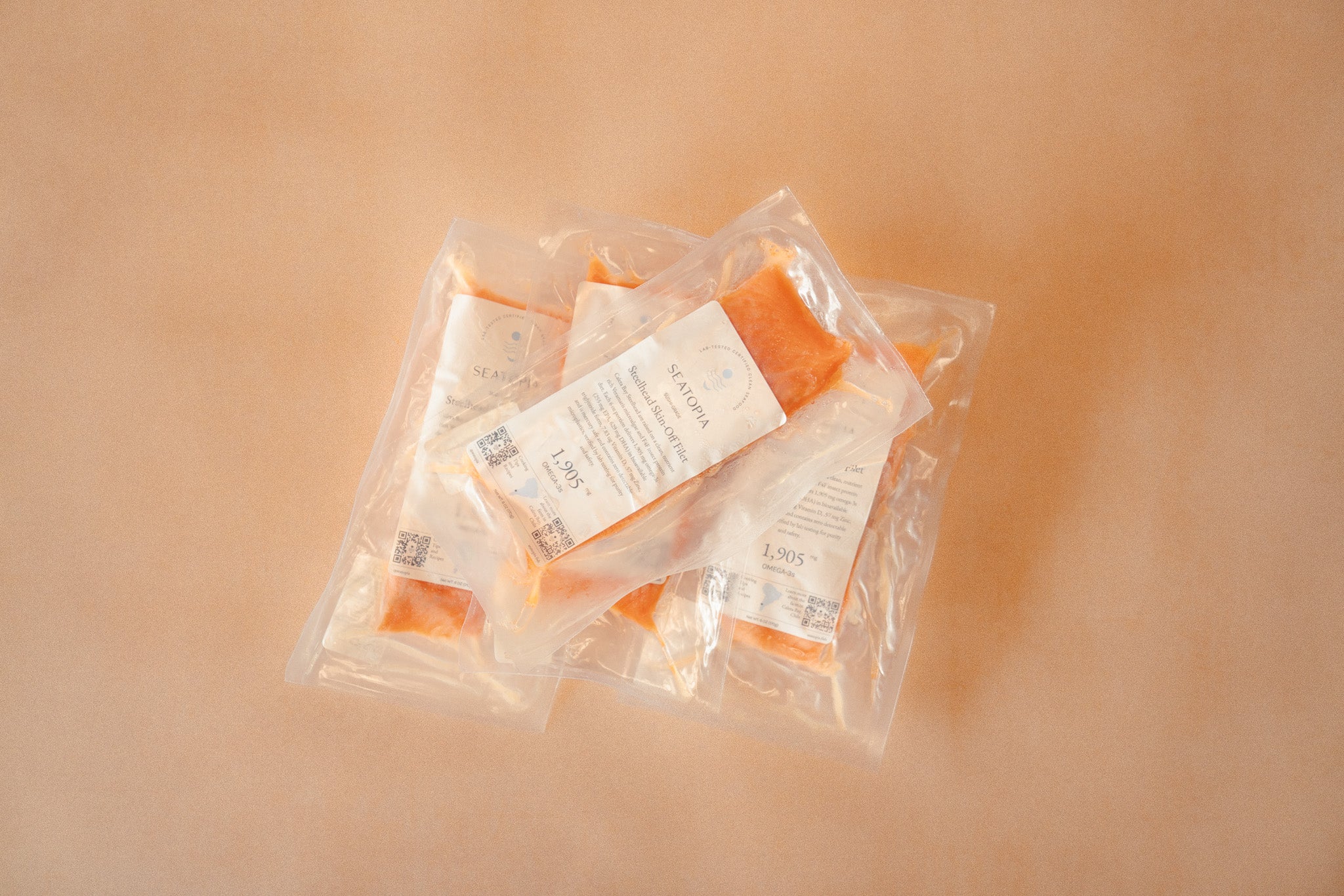
At Seatopia, we take a systems-based approach to everything from feed to freezer. That includes the packaging that protects your fish.
We get it — plastic packaging can feel counterintuitive for an ocean-positive company.
But here’s the surprising truth:
👉 Microplastics in seafood don’t come from BPA-free food packaging. They come from the ocean itself.
Let’s unpack why that matters — and how we’re closing the loop between food safety, sustainability, and science.
What About Microplastics?
This is one of the most common concerns we hear — and for good reason. But it’s also deeply misunderstood.
The plastics found in seafood aren’t leaching from food-safe packaging. They come from the oceans, rivers, and waterways where conventional seafood is caught or raised.
Here’s what really happens:
1. Tiny plankton consume microscopic plastic particles drifting in the water — from synthetic clothing fibers, single-use plastics, and degraded fishing gear.
2. Small fish and filter feeders eat those plankton.
3. Larger fish eat the smaller ones. This process — bioaccumulation — concentrates plastics inside the food chain.
4. As apex predators like tuna or swordfish feed, the concentration magnifies.
That’s biomagnification, and it’s why top-of-the-food-chain species often show the highest levels of microplastics and heavy metals.
Seatopia fish break that cycle. They’re raised in controlled, pristine environments, fed clean, traceable diets, and tested for contaminants before ever reaching your plate.
That’s why every Seatopia product consistently tests with zero detectable microplastics.
So, Is the Packaging Itself Safe?

Yes — and we don’t take that on faith. We verify it.
Our vacuum-sealed packaging is made from BPA-free, food-grade polyethylene, engineered for medical-grade, sub-zero stability. It’s inert, non-leaching, and designed to protect both flavor and nutrients under cryogenic conditions.
But material choice is only half the story.
As part of the Seatopia Standard™, each batch of seafood — in its final, sealed packaging — is submitted for third-party lab testing. Those tests verify mercury, microplastic, and nutrient levels.
✅ Results: Every batch tested to date shows no detectable microplastics.
We don’t assume safety.
We prove it, and we publish the data in our public Certificates of Analysis (COAs).
Our Journey with Sustainable Packaging
We’ve experimented with every next-generation material we could find.
At one point, we worked with Grounded Packaging to test home-compostable, plant-based vacuum bags — a beautiful idea in theory.
But in practice? The materials proved too brittle for super-frozen storage, cracking under cryogenic conditions and risking product integrity.
So, we made a tough call: return to high-performance, BPA-free polyethylene for vacuum sealing — because protecting food quality and safety comes first.
But the story doesn’t end there.
We still partner with Grounded Packaging for our biobased, curbside-recyclable pouches used for shrimp and scallops. These are made from bioresins, reducing reliance on petroleum-based plastics while maintaining the performance needed for frozen seafood.
We’re not claiming perfection. But we are building the bridge — between food safety, performance, and sustainability — and that matters.
Why We Don’t Use Styrofoam — And Never Will
Seatopia has a zero-styrofoam policy.
Expanded polystyrene (EPS) — the white foam used in most seafood shipping boxes — is one of the ocean’s most persistent pollutants. It breaks into micro-fragments that drift for decades, choking marine ecosystems and entering the food chain.
That’s why we ship frozen, not fresh.
Shipping fresh fish would require styrofoam insulation.
By focusing on flash-frozen seafood and curbside-recyclable insulated liners, we’re able to:
-
Preserve peak freshness without harmful packaging
-
Reduce food waste by extending shelf life
-
Lower emissions with lighter, smaller boxes
-
Eliminate single-use foam entirely
It’s not the easiest route. But it’s the right one — for your health and for the ocean.
Conscious Seafood, All the Way
Seatopia is built on a belief that conscious consumption begins with one question:
Where is your food from — and what did it eat?
That awareness extends to every stage of our process:
-
Where the fish is raised
-
How it’s fed
-
How it’s tested
-
How it’s packaged
Our partner farms use microalgae- and insect-based feeds, operate in low-density, pollution-free environments, and never rely on antibiotics or synthetic additives.
And we hold our packaging to the same standard — functional, clean, and constantly evolving.
We’re not here to sustain the status quo.
We’re here to regenerate it — one fish, one farm, one package at a time.
The Seatopia Standard™
-
Mercury-safe (≤0.1 ppm — 10x stricter than FDA)
-
Zero detectable microplastics (tested down to 1 micron)
-
Transparent COAs for every batch
-
Packaging built on science, not assumptions
See the data → Seatopia Standard: COAs & Testing Results
Based on third-party laboratory testing of representative product samples. Seatopia products and packaging are not intended to diagnose, treat, cure, or prevent any disease. Testing results may vary by batch.







Share:
Is Your Sushi Safe? Why the Original Superfood Needs a Modern Clean Label
Selenium: Nature’s Antidote to Mercury — And What It Tells Us About the Seafood We Evolved to Eat