



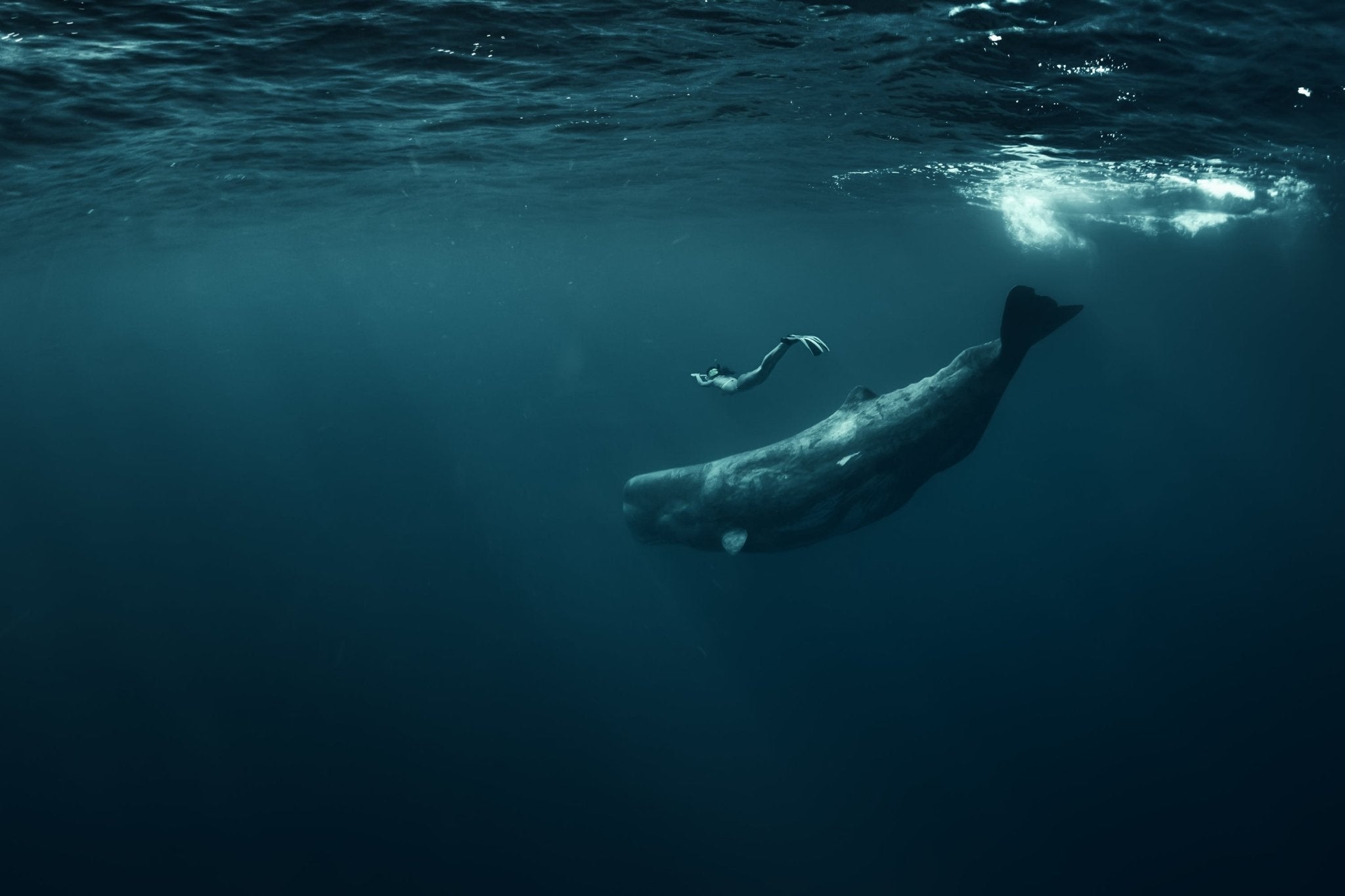
We live in a moment of extraordinary intelligence.
We are building machines that can learn, predict, optimize, and generate. We are mapping genomes, simulating physics, and coordinating global systems at a scale that would have felt impossible just decades ago.
We call this artificial intelligence.
But long before we wrote our first line of code,
there was another intelligence already at work.
The ocean.

The Intelligence We Came From
The ocean is not the backdrop of life.
It is the origin.
It produces more than half of the oxygen we breathe. It regulates climate, cycles nutrients, and gave rise to the earliest forms of life on this planet.
From light to algae…
from algae to DHA…
from DHA to the human brain…
The very structure of our cognition carries a marine signature.
We did not invent intelligence.
We emerged from it.

The Intelligence We Are Building
Today, we stand at the edge of a new frontier.
Artificial intelligence promises to help us model complexity, predict outcomes, and optimize systems in ways never before possible.
And yet, there is a quiet risk embedded in that progress.
That we mistake intelligence for control.
That we build systems faster than we understand the living systems they are meant to serve.
That we forget the intelligence that has always been here.
The Intelligence We Are Learning to See Again
Every organism plays a role.
Not just individually — but as part of a whole.
Reefs are not coral.
Forests are not trees.
Oceans are not fish.
They are relationships.
Symbiotic partnerships.
Feedback loops.
Nutrient cycles.
Migrations.
Signals we are only beginning to understand.
In these systems, 1 + 1 does not equal 2.
It becomes something greater.
Something emergent.
Something alive.
This is ecosystem intelligence.
For the first time in human history, we are beginning to listen.
Projects like Project CETI are attempting to decode the communication of sperm whales — the largest brains on Earth.
Not alien intelligence.
Earth intelligence.
At the same time, we are discovering vast communication networks beneath forests, complex signaling within coral reefs, and dynamic feedback systems across entire ocean basins.
We are surrounded by intelligence.
We have simply not been listening.

Intelligence, Aligned with Life
Artificial intelligence gives us new tools.
The opportunity is not to replace nature’s intelligence —
but to learn from it.
To model:
ecosystem interactions
regeneration cycles
bioremediation pathways
migratory patterns
nutrient flows
To improve logistics.
Reduce waste.
Verify outcomes.
Not in isolation.
But in relationship.
The goal is not artificial intelligence alone.
It is intelligence aligned with life.

Where Regeneration Begins
If the ocean is where life began,
then restoration is not an abstract idea.
It is a responsibility.
Mangroves offer one of the clearest examples of ecosystem intelligence in action.
They stabilize coastlines.
Filter water.
Store carbon.
And serve as nurseries for marine life.
They turn edges into abundance.
And yet, we have lost vast portions of them.
This month, every Seatopia order contributes to planting mangroves.
Not as an offset.
But as participation.
A small act — multiplied across a community —
becomes something else entirely.
Roots in the water.
Habitat returning.
Life multiplying.
A reminder that regeneration is not a theory.
It is something we can choose to be part of.

A Different Kind of System
Today, our supply chain is small.
We work with a handful of farms around the world —
not because that is the final form,
but because they represent what is possible.
The innovators.
The early adopters of a new model.
And today, our market is concentrated.
But the future is not centralized.
The future is distributed.
A global network of regenerative, artisan farms
serving regional communities.
Australia supplied by farms across Australia, New Zealand, Indonesia.
The Americas supplied by farms across their own coastlines.
Europe by its own ecosystems.
Not one system.
But many — connected.
Scale, in this future, does not mean industrialization.
It means replication of intelligent systems.
As demand grows:
more farms adopt regenerative practices
feed systems evolve
ecosystems are integrated into production
costs come down
access expands
And what was once premium becomes standard.
Emerging research suggests that a relatively small portion of ocean space — when used intelligently — could produce a meaningful share of the world’s protein.
Not through extraction.
But through cultivation.
A world where we no longer rely on industrial fishing fleets —
not because we are forced to stop,
but because we no longer need them.
Where seafood is grown in symbiosis with ecosystems.
Where production increases while ecosystems regenerate.
Where wild fisheries recover.
And where fishing returns to something more human:
Cultural.
Recreational.
Reverential.
A Future Worth Building
Imagine the year 2050.
My children — now grown — swim through coral reefs that were once on the brink of collapse.
Reefs we chose to restore.
They move through marine protected areas that are alive with biodiversity.
They free dive among schools of fish that return in patterns we now understand — and protect.
They pass through regenerative aquaculture systems that are not industrial sites,
but living extensions of the ocean.
Kelp forests.
Shellfish.
Finfish.
Working together.
Producing food.
Restoring habitat.
Cycling nutrients.
And perhaps most remarkably…
They do not just observe marine life.
They interact with it.
A generation raised not in separation from the ocean —
but in relationship with it.
Learning.
Listening.
Understanding.

Toward a Real Seatopia
What we are building today is small.
But it points toward something much larger.
A world where food systems regenerate ecosystems.
Where nutrition is measurable and transparent.
Where intelligence — biological and artificial — works in harmony.
Where the ocean is not something we extract from.
But something we partner with.
In the age of artificial intelligence,
the question is not just what we can build—
But what we choose to align with.
The ocean has always known how to create abundance.
How to restore.
How to sustain life at scale.
Perhaps the future is not about escaping this planet.
But finally learning how to live in relationship with it.
Toward a real Seatopia — by 2050.

















Share:
Sushi and Pregnancy: What the FDA and EPA Actually Recommend
Flower Moon Lei Day Reflections: Why We Gather Around the Table