

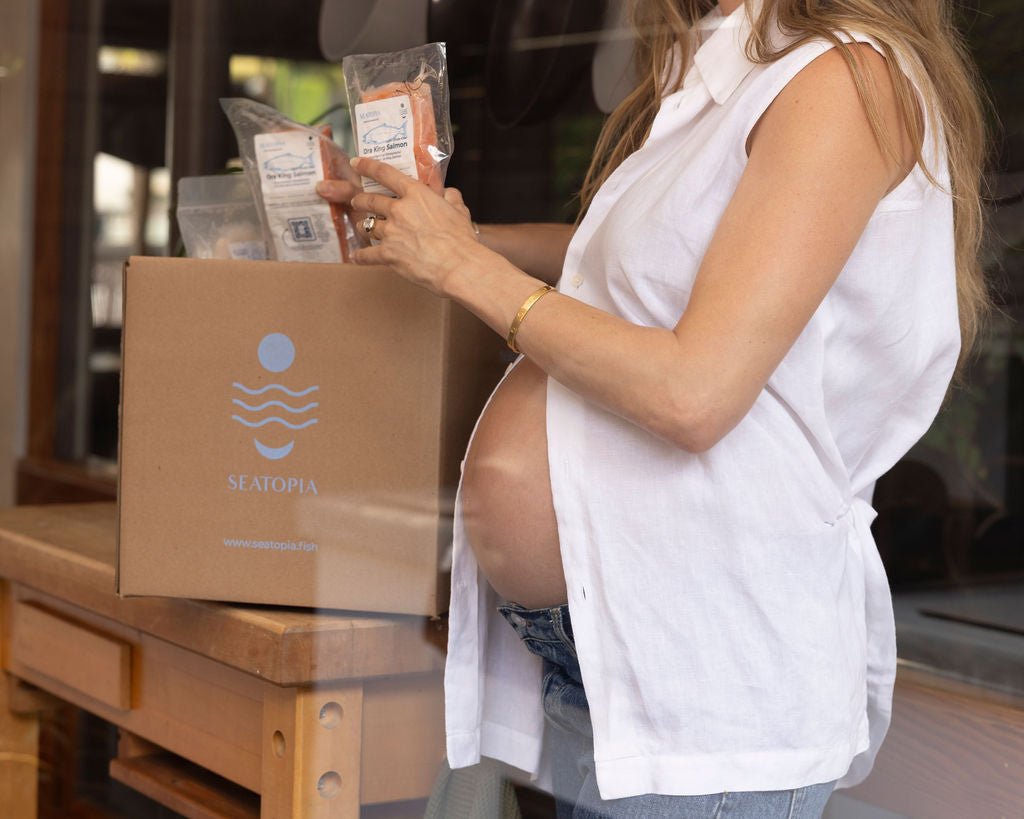
Start with the federal advice, not with a brand
If you are pregnant, breastfeeding, or feeding young children, there is a published, current, government answer to the seafood question, and it is a more useful starting point than anything a seafood company can tell you about its own fish.
FDA and EPA recommend 2 to 3 servings a week, 4 oz each, from their “Best Choices” list for people who are pregnant or breastfeeding. Salmon is on that list.
FDA and EPA recommend 2 servings a week from “Best Choices” for children. Serving size scales with age: roughly 1 oz at ages 1–3, 2 oz at 4–7, 3 oz at 8–10, and 4 oz at 11 and up.
You can read the advice in full here: FDA/EPA Advice About Eating Fish. It lists which species sit in “Best Choices,” which are “Good Choices,” and which to avoid entirely.
Why seafood is on the list at all
Omega-3s are good for you, and fish is the most direct dietary source of the long-chain kind. A capsule gives you two molecules. A fillet gives you the whole matrix — protein, selenium, vitamin D and B12 alongside the fats. That is the reason the advice tells people to eat more fish rather than fewer, and it is why the guidance is framed as a minimum rather than a limit.
The species questions worth asking
- Avoid the big predators. Swordfish, bigeye tuna, king mackerel, shark, marlin, tilefish and orange roughy are on the FDA/EPA “Choices to Avoid” list. Mercury concentrates up the food chain, and these are at the top of it.
- Ask whether the seller publishes lab results. Most do not. A species average is not a result for the fish in front of you, and there is no rule requiring anyone to measure.
- Thaw properly. In the fridge, not on the counter. Eat within 48 hours of thawing.
- Keep it cold and keep it clean. Hold at or below 38°F, and clean your prep surfaces and knives before and after.
- Cook when in doubt. Even a light sear changes the risk profile, and no guidance anywhere asks you to eat fish raw.
On raw fish and freezing
Farmed fish raised in net pens or tanks on formulated feed are exempt from the FDA Food Code’s freezing requirement for parasite destruction. Ours is blast-frozen to −10°F at harvest and vacuum sealed anyway.
Worth knowing: “sushi grade” and “sashimi grade” are not defined or regulated terms in the United States. Anyone can print them. What is actually behind ours is the handling standard — blast-frozen at harvest to −10°F, vacuum sealed, in an accredited facility.
Where our numbers are, if you want them
Seatopia is third-party lab tested for nutrition, mercury and microplastics. Every supplier is tested before we approve them, then randomly audited to ensure consistent compliance with the Seatopia Standard. Our Certificates of Analysis are third-party, from Edacious and EMSL — Edacious covers a 140+ analyte nutrient and contaminant panel, EMSL covers microplastics down to 1 micron.
Farms named, panels published. Scan the QR code on the box and the farm page opens with its panels.
We are not going to tell you what to eat while you are pregnant. FDA and EPA already have, they have done the work to be able to, and their advice is linked above. What we can do is publish what is in the fish and name the farm it came from, so the choice you make is an informed one.

Share:
The Spring Equinox - When Light Returns
Earth Day, in the Age of Oceans and AI - Toward a Real Seatopia by 2050